Showing posts with label social media. Show all posts

Monday, July 17, 2017

The Future of Gaming Consoles

Sales for gaming consoles and video games were less than stellar in 2016. In a market that was a feeding frenzy in years past with people camping out all night to be first in line to buy one, big names like Playstation and XBox are having a tough go. Why is this sector of the gaming industry trending downward?
One word:  digital.
Because you can download amazing games on  your mobile devices, the idea of only being able to play when you are in front of your console is confining. Plus, virtual reality is gaining popularity and again, you use apps on your smartphone to access this type of gaming. There also seems to be a lack of enthusiasm, and this might have to do with the market being saturated with first person shooter type games.
This article from Finder.com.au provides some detailed stats on the future of gaming consoles:

128 million console gamers set to leave the market | finder.com.au

If we forecast ahead through 2017, 2018 and 2019 under the unlikely scenario that the PS4 and Xbox One hold zero change on the 16,000,000 and 7,000,000 they’re expected to sell in 2016 respectively, where do we end up? Roughly another 69,000,000 units sold by 2019. And that would bring the generation’s total up to 157 million.
That’s still 117 million short of the seventh generation of consoles.
More likely, however, we will continue to see a slide year-on-year. If we were to see even a mild – by previous generations standards – 8% drop continue through 2017, 2018 and 2019, a more accurate figure for this generation’s total console install base would actually be 146 million. This would be roughly comprised of 90 million PS4s, 42 million Xbox Ones and 14 million Wii Us.
This would still be around 128 million short of the seventh generation.
Sony and Microsoft are both making upgrades to their gaming consoles in hopes that they can sell a newer version to individuals who already own a PlayStation or Xbox. They are also focusing on mobile, as that is the future of gaming and pretty much everything.
Nintendo-Console
Wikimedia Commons
Nintendo decided to try competing with the Wii market with the Switch, which will be released in March 2017.  The Wii 2, which was released in 2012, was not well received, and the Switch provides similar features so it will be interesting to see how well it sells.  One major bonus for the Nintendo Switch is that it is portable.
This post from TechNewsWorld describes the Nintendo Switch:

Nintendo Banks on Switch Hit | Gaming | TechNewsWorld

Nintendo on Thursday announced the Nintendo Switch handheld gaming console, its long-awaited successor to the poorly received Wii 2.
The US$300 Switch will hit the streets March 3. Purchasers will get the console, two Joy-Con controllers, a Joy-Con Grip, a set of Joy-Con wrist straps, a Nintendo Switch dock, an HDMI cable and an AC adapter.
The Switch has a 6.2-inch capacitive multitouch screen and a kickstand.
The Switch can be used as an independent handheld player. Battery life ranges from 2.5 to 6 hours.
This review of the Switch is by a couple that were given a chance to do some hands-on testing of the system. They really enjoyed their experience and think it will be a big hit. Their descriptions of all of the games they tried were pretty entertaining.
See the original blog here: S&S Pro Blog

Sunday, June 25, 2017

How Critical is Social Media to a Small Business?

Big businesses with tons of resources, employees, and bigger marketing budgets are plentiful, but there are also 28 million small businesses across the U.S. which account for 54% of all sales. Another interesting fact is that big business has eliminated 4 million jobs since 1990, but small business has created 8
Business Networking
Image from Pixabay
million. Basically, smaller companies are a vital part of what makes our country successful.
Owning a small business is also what gives people hope; following their dream, not relying on someone else to earn a living, and having the flexibility to create their own schedule.
With owning a small business, you are required to wear a lot of hats. You are the accountant, HR department, investment officer, marketing director and much more. As the one making decisions about online marketing, how much time should you delegate each day to social media?
In this article by Susan Friesen at Business2Community.com, she presents compelling reasons to allot a part of your day to connecting on social media:

Is Social Media Really Worth It For A Small Business?

Since time costs money to business owners, let’s look at the amount of time the average business owner spends on social media.
According to a survey by Vertical Response, about 43 percent of small businesses spend about 6 hours per week on social media.
Writing and posting a weekly blog post can take 1-3 hours to do. So this means it takes a full day to write, schedule, and post to social media plus write Social media and Businessand post a blog article each week.
This is assuming you, the business owner would be doing everything required to fulfil these two marketing tasks. If you decide to hire someone to help, then the money you pay out needs to be the ROI factor as opposed to your time.
On the flip side let’s look at the advantages of social media for your business. In general, there are 5 benefits a business owner can count on if using social media marketing:
1. Relationship Building: Social media is an excellent way to build relationships with prospects. It provides an opportunity for multiple exposures to your fan base by using a mixture of information and calls to action.
2. Lead Generation: Add followers to your email marketing list by sharing links to downloadable freebies on your social media accounts. This allows you to send follow-up emails and information that can lead to sales.
3. Traffic Generation: SEO optimized blog posts can help your website rank higher for important keywords in the search engines. Plus, when you post blog articles, you can tell your social media followers about them and share the link to your blog to read more.
4. Consistency: Staying top of mind requires frequent marketing touches. With many people spending hours a day checking their Facebook, Twitter, and LinkedIn accounts on their smart phones, social media gives you lots of exposure to your target market.Sharing daily social media posts and weekly blog articles keeps the relationship with your customers strong.
5. Customer Service: Social media offers an easy way for customers to reach you with questions, problems, or complaints about your products and services.This gives you a chance to respond immediately to address the issue. Plus, giving the VIP treatment to customers in need shows that you are a company who cares and goes a long way towards building your reputation online.
This infographic is part of the Vertical Response survey that was mentioned in the above article. It offers some intriguing stats on how much time small businesses spend on social media. Amazing that 90% of all small businesses have a presence on Facebook:
Time spent on social media by small businesses
Infographic via Vertical Response
Due to the fact that most business owners fail to show an actual return on their investment when using social media, you can imagine the lack of faith and level of frustration. On one hand, you are spending precious time creating relationships that don’t result in any income. But on the other hand, you will be left in the dust as far as brand awareness by everyone else who is using social media.
So the question “how critical is social media to a small business?” isn’t easily answered. Figuring out a way to monetize your efforts will make the time spent worth it.  In this Inc.com post, author Carolyn M. Brown provides some tips for generating income through social media outlets:

How to Monetize Social Media | Inc.com

How to Monetize Social Media: Build Brand Awareness
The first step is to use traditional media or word-of-mouth advertising to drive awareness and traffic to your Twitter, Facebook, YouTube, Linkedin or
Social Media Likes
From Pixabay
Myspace pages, says Jamie Turner, author of How to Make Money with Social Media. Unless you already have a recognizable brand like Nike or Apple, your brand needs to develop social media magnetism before you can look to make any money. You also need to create circular momentum across many platforms when designing your social media campaign, says Turner. By providing multiple channels for users to talk with you, you let customers choose the channel that they are most comfortable with, he adds; and by doing that you increase the likelihood that they’ll connect with your brand in any number of ways.
How to Monetize Social Media: Engage Your Audience
Social media is about having a dialogue. When you have a dialogue with a customer or prospect, the communication is much more fulfilling and much more profitable, says Turner. The PETCO brand has developed a strong presence in social media. The pet store chain has a YouTube channel, its Facebook page generates a lot of discussions among pet owners, and there’s lots of activity on its PETCO Scoop blog, which has received hundreds of ‘likes’ and comments. PETCO’s customers are true pet lovers and treat their pets as part of the family. The company tries to keep conversation going by aiming Facebook and Twitter posts so that there’s an explicit question to answer, or at least a specific piece of information to which people can react. Industry experts stress that you have to know your community and know how to take part within that community and through that create great content or conversation that will raise awareness and increase sales.
Read the full post here…How to Monetize Social Media | Inc.com
The previous article is one of many that are out on the internet to help people use social media to their advantage. My advice is that your primary objective has to be listening to what people are saying, finding those that are unhappy with or looking for a service or product you supply, and offering your services instead in a way that doesn’t come across pushy.
This is not a task that can be done quickly, but by using social media as a search engine for new clients, it can bring in more traffic to your company, keep you in the front of your follower’s minds, and increase your brand exposure.

Original post on S&S Pro Blog

Sunday, June 18, 2017

How Pinterest Promoted Videos Will Work

Social media platforms are part of our daily lives and popular with all age groups, but yet many have struggled to monetize their product. Pinterest is no different.  I love the images that are shared there, but like many others, I don’t want to pay to see them.
As a business owner, though, it makes sense to promote yourself on social media. There are so many daily viewers and regular users of some of the well known platforms, and their ranking is displayed in the graph below. As you can see, Pinterest is toward the lower end of active users, but with their new promoted videos, this statistic could change.
Social Media Active Users Stats
To keep up with the times, businesses are figuring out ways to take advantage of all the eyeballs and bring more traffic. Pinterest is reportedly worth $3.8 billion but has no revenue, so they are working on a strategy to help advertisers improve brand awareness and share their pins with a bigger audience by using promoted videos.
This post from Search Engine Journal by writer Danny Goodwin provides more insight into how Pinterest promoted videos will work.

5 Things to Know About Pinterest Promoted Videos – Search Engine Journal

https://www.searchenginejournal.com/pinterest-promoted-videos/171280/Pinterest has announced the launch a new type of video advertising called Promoted Video Ads. The new ads are designed as another way to help brands drive more sales on Pinterest.
Here are five things marketers need to know about Pinterest’s Promoted Videos.

1. What Are Promoted Videos

Promoted Videos are a new ad type that Pinterest users will see in their feed. For now Promoted Videos are only available on mobile, but a desktop version is expected at some point in the future.
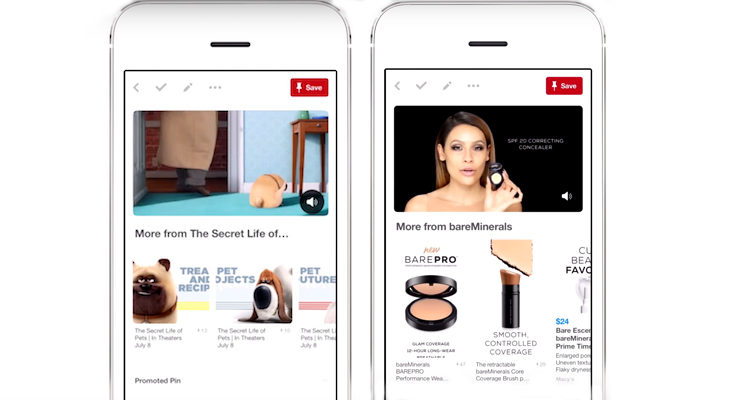
Promoted Videos will first appear as a Cinematic Pin, which is similar to a GIF. Advertisers can choose which images appear in it. Clicking on that Pin leads users to a new page with Pinterest’s new native video player.
The Promoted Videos play with sound on by default. Users can tap to watch the video ad in full screen.
Six featured pins appear underneath the Promoted Video. Pinterest is hoping that Promoted Videos will inspire users to take action (i.e., buy from the brand after watching their video).

2. How Much Do Promoted Videos Cost?

You can buy Promoted Videos on a CPM basis ($15 to $20 per thousand impressions). A $500,000 minimum investment is required, Ad Age reported.
You pay anytime a Pinterest user sees your Cinematic Pin for the Promoted Video, even if that user never views your video.
Here are the metrics Pinterest will share with advertisers about their Promoted Video:
  • Impressions.
  • Video views (and how many watched 25, 50, 75, and 100 percent of the video).
  • Clicks generated.
In an article from Social Media Examiner, there is a sample of what a promoted video on Pinterest will look like.
Pinterest was started in 2009, so it’s not a new startup. Facebook had a five year jump on Pinterest, as it was created in 2004, and it took Facebook until 2009 to become profitable. It will be interesting to see if Pinterest newest strategy helps them to begin monetizing their company.

Original post found on S&S Pro Blog

Sunday, June 11, 2017

The Best Way To Manage Negative Comments

You know you have made it to the big leagues when you start receiving a lot of comments and feedback on your blog or social media accounts. If you spend much time writing, then you truly do hope that people actually read what you post, especially if it’s something you’re passionate about. With that, you’d like to engage your readers and hear what they think of your information.
That’s how it should be if you have a lot of confidence in yourself and your writing.
But, if you are the non-confrontational type, then it is a little scary dealing with others and their opinions.  One thing I’ve noticed is that when people post online, they feel they are somehow anonymous and can just say whatever they want, even if it is malicious and destructive. I guess you can be more brave when you are hiding behind a computer screen or smartphone, and possibly a fake name and profile pic.
The best answer for negative feedback is to meet it head on. If you can resolve a conflict in a calm, caring and considerate way, you will usually come out of it looking like a well managed individual or company. The problem is that there are all types of personalities giving feedback and you aren’t going to be able to please them all.
This article by Content Marketing Institute provides some excellent advice on the best way to manage negative comments and criticisms, whether they are constructive or not.

When Content Backfires: How to Handle Negative Feedback Online

As your followers and traffic grow, so does the potential for ruthless people to emerge.
Sometimes they have good reason.
Sometimes they’re just trolls who want to squash your content into jelly.
No matter how hard you try, it’s impossible to keep an audience happy. Your comments section and social media are the go-to destinations for disgruntled people.
Once those complaints live on the web, they’re not likely to disappear unless you take the shady route (hiding and deleting them is not recommended … I’ll get to that shortly).
It’s not the presence of the complaints, debates, or negative responses that matters; what matters is what you do once those comments roll in.
You need a professional approach to managing the community around your content. That means creating a policy and process for handling feedback — all types, not just the negative stuff. It should also go beyond your blog comments to include things such as Facebook engagement and other social platforms you use.
Most feedback needs to be passed along to the proper people, taken into consideration, and responded to. When urgent matters pop up, you don’t want to scramble to figure out how to respond.
You want documentation that states who handles what type of feedback, and who is accountable for generating the response and continuing the engagement with the individual. You also want response times clearly defined. This makes the process run much more smoothly.
An audience-facing policy also needs to be created that sets boundaries for your readers. This lets them know what is acceptable, what kinds of activity earn them a boot, and how you handle comments. It’s a good way to prevent problematic behavior from showing up.
Lee Odden, CEO of TopRank Marketing, offers these guidelines to manage expectations of how he handles the comment section of his blog. Readers are put on notice of what’s acceptable and what’s not.
Blog Comment Policy Lee Odden
Tim Ferriss, author of the 4-Hour Workweek takes a humorous approach in the comment policy for his site:
“Comment Rules: Remember what Fonzie was like? Cool. That’s how we’re gonna be – cool. Critical is fine, but if you’re rude, we’ll delete your stuff. Please do not put your URL in the comment text and please use your PERSONAL name or initials and not your business name, as the latter comes off like spam. Have fun and thanks for adding to the conversation!”
Smart businesses that publish highly trafficked content take a similar approach with comment policies. Check out this policy from Mayo Clinic:
“We encourage your comments on Mayo Clinic’s various blogs, and hope you will join the discussions. We can’t respond to every comment, particularly those that deal with individual medical cases and issues. We review comments before they’re posted, and those that are off-topic or clearly promoting a commercial product generally won’t make the cut. We also expect a basic level of civility; disagreements are fine, but mutual respect is a must, and profanity or abusive language are out-of-bounds.”
Having a policy is a start, but it’s a simple and passive approach. It might help diminish unwanted behavior, but has a policy ever really stopped an angry or irate reader from leaving a comment?
When they hit submit, you want to be ready with a response that goes beyond simply deleting comments.

Classify Negative Feedback

Negative feedback can take a lot of forms. Not all negative feedback is the same, and not every negative commenter is out to destroy your reputation.
Simply Measured established a few distinct types of feedback, which I’ve tweaked to reflect what I’ve experienced:
  • Bluster: Blusters are chaotic responses generated from frustrated rambling. The individual is indignant, upset, and frustrated, but they’re not capable of getting a point across. That doesn’t mean they don’t have a point or that they’re a troll; they just can’t accurately convey their issue. At the least, you know they’re upset, so that’s a start. It’ll take some digging to identify their true issue.
  • Pressing: This is a critical feedback point that’s a heads-up of a serious problem. It could be an issue with your fact checking, broken links, formatting and readability, or even a busted opt-in. It’s something you want to act on immediately.
  • Disgruntled: Your nasty audience members are mad as hell over something trivial or something big. They typically tell you (sometimes at length) exactly what the problem is. Rarely can you reason with them.
  • Constructive: This negative feedback comes with good intentions and it’s probably what you’ll see most often from followers. A good example of this is someone letting you know that you missed key points in your content. They’ll usually list what you missed.
They might tell you that something was confusing, or that you contradicted yourself in specific spots. It’s a good opportunity to modify your content and learn from the experience.
Pore through reputation management tips and books, and you’ll read time and again about how you should publicly respond to every comment, even the negative ones. It’s supposed to paint you and your brand in a positive light because others see how you handle situations.
It’s true that you should respond to everything … within reason. Here’s how Nestle engaged commenters in a Facebook post:
Nestle's Response to Negative Comments
Some situations are far beyond mediation, especially when you’re dealing with a disgruntled commenter. You should absolutely respond to pressing and constructive feedback, and work with bluster comments to try to sort out their concerns.
Aim to respond to 90% of the disgruntled comments. If applicable, apologize, or find or offer a solution even if it means just offering to consider their concern in the future.
If it’s an antagonistic comment that in no way contributes to the discussion, then opt out of the conversation.
Comments are an essential engagement element. Just don’t feed the trolls.
Remember, responding to everyone and every comment is not your priority. Your priority is to have patience.
Every comment, no matter how ill-informed or irrational, is an opportunity. The better your response, the more respect you’ll gain from the community overall.

Consider Alternative Approaches


Dealing with difficult comments can drain energy and be a huge time-suck, especially when you get caught up in a back and forth. Here are some additional strategies for dealing with negative feedback on your content:
      1. Comment Moderation

        Most content management systems and comment platforms give you the ability to turn on various degrees of comment moderation before a comment goes live.
        You can require registration for comments, require individual comment approval, or grant automatic approval for future comments once the respondent’s first comment goes live.
        The biggest benefit to moderating comments is that you can catch negative feedback before it goes public. You have the opportunity to respond to the individual privately, provided an email is included.
      2. Delete Comments

        I don’t recommend deleting negative comments and feedback — at least feedback that’s constructive or contributes to the overall discussion.
        Disgruntled comments and people trolling are another story, and deleting comments that would be out of bounds might be a good strategy to take. The same goes for comment spam.
      3. Ignore ‘Em

        In situations where you’re dealing with a highly aggressive, irrationally angry person it can sometimes be best to just ignore the comment. This is especially true if the individual isn’t looking for any kind of solution and is only interested in attacking you.
        If they do have a complaint that you can address, discuss that specific issue and ignore the rest of the ranting and insults. Keep your responses short and don’t engage beyond providing a solution. That will just pull you away, waste time, and could potentially spiral into a worse issue.
      4. Take It Offline

        When you get negative feedback from someone, even constructive criticism, you don’t really know what it could turn into.
        Any conversation stemming from negative feedback has a potential to spiral out of control, especially if other commenters jump on board. You may want to consider just responding to people privately through email or through a direct message on social media.

Don’t Take It Personally

With the volume of content you create, sooner or later you’re likely to rub someone the wrong way or have people disagree with you. Don’t let it impact you personally, and don’t lose sleep over it.
Do your best to listen to feedback on your content, apologize when appropriate, provide a solution if you can, and always remember to thank people — especially when dealing with negative feedback. When Content Backfires: How to Handle Negative Feedback Online
Even though this infographic from HubSpot relates more to providing feedback to employees, it still provides relevant insight and tips as to why negative feedback is better than no feedback at all.


bad-feedback-better-infographic
Blog Originally Posted on S&S Pro Services