Showing posts with label advertising. Show all posts

Friday, June 23, 2017

How Will Verizon Utilize Yahoo?

In July of 2016, Verizon acquired Yahoo for a mere $4.8 billion. This means that Yahoo, one of the big online names from the 90’s through the early 2000’s, is
Mobile Device
Wikimedia Commons
no longer an independent company. Yahoo had been struggling to keep its stock value up even with all of the impressive stats of the past.
What’s the reason? One word:  Mobile.
As mobile use has climbed exponentially, Yahoo didn’t keep pace. So why would Verizon, a major player in the mobile market, want to own Yahoo?
This article from Entrepreneur Magazine writer AJ Agrawal describes how Verizon will utilize Yahoo and what the investment means to mobile marketing:

Verizon Purchased Yahoo: What Does This Mean for You?

Mobile video will become even bigger

When one looks at the rise of mobile, it’s easy to see why Verizon decided to make this deal. Marketers are taking advantage of mobile and they will soon
be able to take advantage of a combined mobile network and content-marketing machine.
Yahoo comes with an enormous amount of content. And this is content people are still reading on a regular basis. With more and more people reading from a mobile device, an unprecedented opportunity presents itself for marketers to hit mobile browsers.
Verizon runs one of the largest mobile networks in the United States, and it’s widely expected that the company will combine its mobile network with a huge cache of content. The content footprint will be much bigger, as a result.

Advertisers will find it easier to track their results.

What a lot of people haven’t yet talked about is how Verizon has managed to gain control of the Yahoo Gemini ad platform and the mobile analytics suite Flurry. Flurry is the interesting acquisition for advertisers because it’s universally recognized as one of the better ones for tracking results.
Verizon hasn’t made any announcements on the future of Flurry, but if it intends on appealing to advertisers, it will either keep or rebrand it.

Data that advertisers use will be cleaner.

Verizon Wireless Logo
Wikimedia Commons
Advertisers always want clean and accurate data when they deal with a platform. Yahoo has always had the problem of hosting thousands of Yahoo Mail accounts that are out of data and unused. It’s widely expected that Verizon will clean these up to demonstrate to advertisers that the data it has is relevant.
This is good news for marketers because they will know exactly where they stand when it comes to the numbers they have at their disposal. It’s not yet known whether these accounts will simply be deleted, though.

Will the new Yahoo acquisition provide another viable advertising platform for marketers?

Despite the coming together of two big brands like Yahoo and AOL, the number of regular users is still lacking compared to those on Facebook and Google. There’s still no competition there, but that doesn’t mean marketers should completely discount using Verizon as an advertising platform.
Mobile advertising is continuing to grow at an exponential rate, and Verizon controls a huge amount of the mobile network in the United States. The leveraging of this huge network could make Verizon a “must have” for mobile advertisers in the coming years.
This video by Anthony Tornambe gives a quick replay of the purchase and reiterates that the reason for Verizon wanting to buy Yahoo.  At 1:40, he provides a quote from the former CEO, Marissa Mayer on what the buyout means for Yahoo. Of course, the fact that she is receiving a $50 million severance package might help to make the pain of failure a little easier.


Interestingly, throughout the process of acquiring Yahoo, Verizon is also announced they are buying Sensity Systems, a company that helps businesses transition from older, less efficient lighting systems to LED lighting systems that can be remotely controlled. This tweet links to an article about the purchase:

Verizon has been busy buying up a lot of companies in the last few years. Names such as AOL, Telogis, and Fleetmatics are part of the big picture that Verizon is designing. Maybe they are going to challenge names like Facebook and Google for the top big players in technology and IoT.

First seen on S&S Pro Blog

Tuesday, June 13, 2017

The Differences Between Vine and Giphy

Twitter’s six-second looping video app, Vine, is going to be shutting down soon. The reason is partially that Twitter is struggling to be in the black with their revenue, but also that Twitter is still trying to find itself.  Additionally, other companies jumped into the same video space and moved ahead of Vine in popularity, such as Instagram, Snapchat, and Giphy.
Vine was bought by Twitter in 2012 and was initially an online hit. However, with Vine’s headquarters in New York and Twitter’s in California, this apparently caused a disconnect. They also struggled to keep the leadership role at Vine consistent, with people leaving to take other positions, which didn’t help the situation. In this article by The Verge, more detail about the situation are explained:

Why Vine died – The Verge

The thing about Vine becoming the internet’s premier tool for making short-form videos is that it happened almost completely by accident. Its founders had envisioned their tool for making 6-second clips as a way to help people capture casual moments in their lives and share them with friends. It was
part of their pitch to Twitter, which bought the company for a reported $30 million in October 2012, seeing it as a near-perfect video analog to its flagship app’s short-form text posts.
And yet even before the app launched, users had taken the 6-second constraint as a creative challenge. Something about that loop — the way a Vine endlessly rewound itself after completing, like a GIF with audio — encouraged people to put the app to strange uses. “It was surprising,” said Dom Hofmann, who founded Vine with Rus Yusupov and Colin Kroll four months before Twitter bought it. “Our original beta had something like 10 or 15 people on it, and even with that small group we started to see experimentation pretty early on.”
Within weeks, it appeared that Vine probably would never become the everyday video sharing tool its founders had envisioned. Instead it became something wilder — and much more culturally interesting. “It became pretty clear as soon after we launched,” Hofmann said. “Watching the community and the tool push on each other was exciting and unreal, and almost immediately it became clear that Vine’s culture was going to shift towards creativity and experimentation.”
On Thursday, the experimentation came to an end. With its own future increasingly uncertain, Twitter said it would shut down Vine’s mobile app some time in the next few months. And while existing Vines will remain on the web, a media format that had become beloved for its versatility now appears headed the way of Betamax.
Read the original post here:  Why Vine died – The Verge
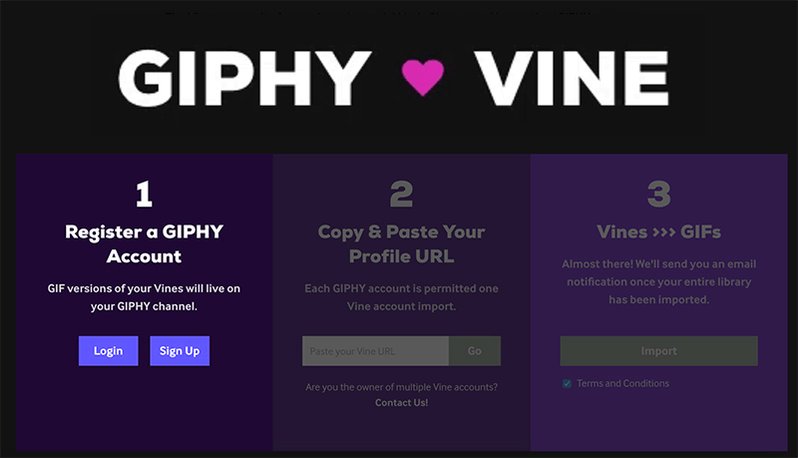
Giphy, another looping video app, is extremely popular right now. It has a lot of similarities to Vine, and is now allowing Vine users to import their videos to their service. Ironically, this post is from Giphy’s Twitter account:
So what are the differences between Vine and Giphy? They both have difficulty monetizing their product, but Giphy is valued at $600 million dollars. This type of platform with short looping video clips that are entertaining and invoke emotions, like a moving emoticon, might be the future of media.  Could it have something to do with our attention span? Probably so, but this article from Fortune explains further why the company is valued so high:

Animated GIF Company Giphy Has No Revenue But Is Worth $600 Million

http://fortune.com/2016/10/31/giphy-funding/Whether it’s on Twitter, Facebook, or in your company’s Slack inter-office chat threads, you’ve probably seen hundreds of them—animated GIFs of Donald Trump making faces, or of popular Internet “memes,” like the little girl doing the rock salute while four-wheel drifting in her toy Corvette.
These little mini-clips may be fun, but does that justify giving one of the companies that create them a market value of $600 million? By way of comparison, that’s more than twice what Amazon CEO Jeff Bezos paid for the Washington Post.
Giphy, which was created in 2013 as part of the New York-based venture fund/incubator Betaworks, got this valuation by raising a Series D funding round of $75 million from a series of venture capital investors. That doubled the amount the company has raised so far, and coincidentally also doubled its valuation to $600 million.
If you’re wondering what Giphy’s valuation works out to as a multiple of revenue, the answer is that it’s almost infinite — because the company doesn’t really have any revenue to speak of.
So then why should this business be worth $600 million? Giphy and its investors argue that it is essentially a model for a new kind of media company. It creates bite-sized pieces of video that can go incredibly viral in a matter of minutes, whether it’s about the election campaign or a popular TV show.
A GIF, also known as graphic interchange format, is an image file that supports both still shots and animated videos, and it is where Giphy got their name. The image below is an example of a GIF from Giphy. You can see that it just keeps looping the same clip over and over.
http://media4.giphy.com/media/3o6Ztg3pBzYATS5mGA/giphy.gif
I also thought the GIF was somewhat of a statement for how hard it is to monetize these types of platforms…the money is there but you can’t quite grasp it. Media platforms have their work cut out for them as far as discovering the best way to earn revenue through these creative communication tools. The battle for catching the viewers’ attention and dollars will prove who is the most imaginative entrepreneur.

The post was originally seen on S&S Pro Services Blog